
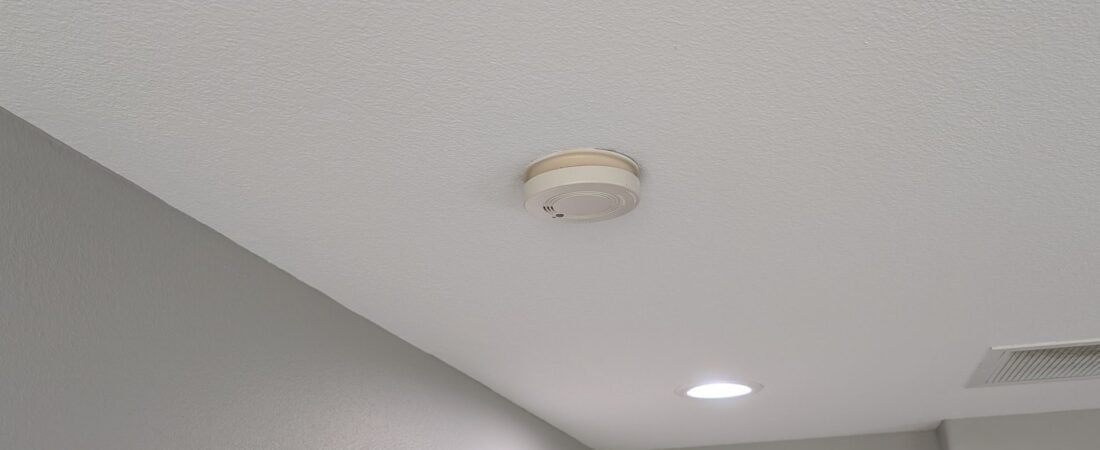
Smoke Detector Placement: A Firefighter’s Guide to Where They Actually Belong
Most house fires I responded to over 25 years had one thing in common: they started while people were asleep. A working smoke detector, placed correctly, is still the single biggest factor in whether a family wakes up in time. Not the type of detector. Not the brand. Placement. Of course, it must also be in good working condition — more on care and maintenance a little later.
I’ve walked into homes after fires where every bedroom had a detector — except the one where the fire started. I’ve seen detectors mounted too close to the kitchen stove, so sensitive to cooking smoke that families disabled them entirely. Both mistakes are common, dangerous, and easy to fix once you know what to look for.
In this guide, I’ll walk you through which type to choose and exactly where to install it so your home is better protected.
Types of Smoke Detectors: The Short Version
You don’t need to become an expert here — just enough to make a smart purchase.
Ionization detectors respond fastest to flaming fires (the kind that burn hot and spread quickly, like a grease fire or burning paper). They’re also more prone to false alarms from cooking smoke.
Photoelectric detectors respond fastest to smoldering fires (the kind that start slow — a cigarette in a couch cushion, an electrical short in a wall). They’re less likely to false-alarm from cooking, which is why they’re a better fit near kitchens.
Dual-sensor detectors combine both technologies in one unit. This is what I recommend for most homes, most rooms — you’re covered for both fire types without having to think about which one fits which room.
The National Fire Protection Association (NFPA) recommends either dual-sensor detectors or a combination of both ionization and photoelectric detectors throughout the home, since no single technology catches everything equally fast.
Where to Place Smoke Detectors
This is the part that actually saves lives, so let’s get specific.
Every Bedroom
This is the most commonly missed spot, and it’s the most important one. If a fire starts elsewhere in the house at night, a closed bedroom door can block smoke and sound long enough that a hallway detector alone won’t wake the people inside in time. Every bedroom needs its own detector — no exceptions, no “the hallway one is close enough.”
Outside Every Sleeping Area
In addition to inside each bedroom, place a detector in the hallway or common area directly outside the sleeping areas. If bedrooms are spread across the home rather than clustered together, you may need more than one hallway detector to cover all of them.
On Every Level of the Home
Basements, main floors, upper floors — every level needs at least one detector, including basements even if no one sleeps down there. Basement fires (often electrical or related to furnaces/water heaters) can spread upward through stairwells before a main-floor detector ever picks up on it.
Mounting Height and Position
Smoke rises, so:
- Ceiling-mounted is the first choice — place it in the center of the room or hallway if possible.
- If wall-mounted, position it 4–12 inches down from the ceiling, never lower.
- Avoid corners where walls meet the ceiling — air doesn’t circulate well there, which can delay smoke reaching the sensor.
Distance from Kitchens and Bathrooms
Keep detectors at least 10 feet from cooking appliances to cut down on false alarms from normal cooking smoke and steam. If your kitchen is small and 10 feet isn’t possible, a photoelectric detector (mentioned above) will give you fewer nuisance alarms than an ionization model in that spot.
What to Avoid
- Don’t place detectors near windows, doors, or air vents/ducts — airflow can pull smoke away from the sensor before it detects anything.
- Don’t place them directly above a stove, in a garage prone to exhaust fumes, or in areas with high humidity (like right outside a shower) unless the unit is specifically rated for that environment.
Interconnected Detectors: An Extra Layer of Warning
Some brands offer wireless interlink systems, where every detector in the home communicates with the others. Say a fire starts in the living room while everyone’s asleep upstairs — with standalone detectors, it can take time for smoke to travel far enough to reach a bedroom unit. With an interconnected system, the moment one detector senses smoke, every detector in the house sounds at once. That earlier, house-wide warning can matter, especially for larger homes or homes where bedrooms are far from where a fire is likely to start.
Maintenance: The Part Everyone Skips
A correctly placed detector with a dead battery is just a piece of plastic on your ceiling. A few numbers worth remembering:
- Test monthly — press the test button, confirm the alarm sounds.
- Replace batteries at least once a year (or immediately when you hear the low-battery chirp) — many people tie this to a clock change or another yearly reminder.
- Replace the entire unit every 10 years. Smoke detector sensors degrade over time, even if the battery is fresh. Check the manufacture date printed on the back of the unit — if you don’t know how old yours is, it’s probably time.
The Bottom Line
Smoke detectors work. The vast majority of home fire deaths happen in homes with no working smoke alarms — not because the technology failed, but because a detector was missing, disabled, or dead. Walk through your home room by room this week. Count your bedrooms. Count your levels. Make sure every one of them has a working detector, placed the right way.
Life safety is the priority here, and a working smoke detector, properly placed, gives you an early warning of a fire in your home. That warning can be the difference between living and dying — most deaths in residential fires are from smoke inhalation, not burns.
It takes twenty minutes. It’s worth every one of them.